Following are three poems by W.B. Yeats. The first two, ” The Song of Wandering Aengus” and “Who Goes with Fergus? ” were written between 1892 and 1897, years when Yeats often drew his subjects from Irish mythology and called himself, “one of the last Romantics.” The third, ” The Second Coming,” was written after the disastrous WW1, in 1919, a time of bitterness, loss of faith, mourning.
“The Song of Wandering Aengus”
I’ve always been haunted by the musical rhythm of this poem. Reading the first stanza aloud, the child-like repetition of the iambic meter and the simplicity of the word choice took me, like a song, to a faraway land and time. Going into the hazel wood, “because a fire” was “in his head, ” Aengus relates, step by step, his delicate preparation to fish and he waits for the right moment, “when white moths were on the wing, / And moth-like stars were flickering out,” infusing the air with a ghostliness before he lowers the thread.
The story continues, Aengus, getting the fire ready to cook the fish, hears someone call his name and a dazzling sight is there before him: the “little silver trout” has miraculously turned into a “glimmering girl with apple blossoms in her hair.” She then runs away “through the brightening air, ” and the vision fades.
The change in the last stanza is what struck me most. Suddenly old, Aengus’ narrative voice becomes lyrical, lilting, ” Though I am old with wandering/ through hollow lands and hilly lands,/ I will find out where she has gone, / And kiss her lips and take her hands;/ And walk among long dappled grass.” I wondered, like most readers, what the girl represented to Yeats. Was it his great, unrequited love, Maud Gonne? I didn’t think so. He usually wrote about her more directly. This poem has a transcendent quality.
Fascinated by it for years, I never felt the need to research Aengus. But recently I did and found out why Yeats chose this god of Irish mythology. Aengus was a king, the god of love, youth, and, important here, poetic inspiration. Of the many tales told of him, one was that he saw a girl in his dreams and fell in love with her. For years he searched and finally found her, imprisoned by a spell that turned her, and 150 other girls , into swans. He was told that if he could identify her among the others, he could marry her. A gifted god, he turned himself into a swan, called out to her, and together they flew away, singing a beautiful song.
The parallels are clear, but Yeats’ Aengus, unlike the mythical Aengus who had captured his love, is still wandering, longing for the one who had so affected him. Yet he doesn’t give up: ” I will find out where she has gone,” and then, “pluck till time and times are done/ The silver apples of the moon, / The golden apples of the sun.” The sensuous loveliness of the imagery suggests that the ” fire in his head” has been quelled by the gift of the glimmering girl: the inspiration to express what he feels in the language of poetry.
“Who Goes With Fergus?”
WHO will go drive with Fergus now,
And pierce the deep wood’s woven shade,
And dance upon the level shore?
Young man, lift up your russet brow,
And lift your tender eyelids, maid,
And brood on hopes and fear no more.
And no more turn aside and brood
Upon love’s bitter mystery;
For Fergus rules the brazen cars,
And rules the shadows of the wood,
And the white breast of the dim sea
And all dishevelled wandering stars.
My favorite poem. It’s provocative, mysterious, and the imagery is compelling. In the first sentence, the title subject, Fergus, is driving and the capitalized “WHO” implies “who will be brave enough,” or willing, to join him? And the final word, “now”, tells us that this is new, a venture that is about to happen. The image in line 2, that Fergus will “pierce the deep wood’s woven shade,” affects you almost physically : “pierce” is sharp, knife-like, and the shade , entwined in the thickness of the trees, feels alive in its presence. Then, an immediate change, the followers will “dance upon the level shore,” freely moving, no barriers. The speaker urges a young man: “lift up your russet brow, ” and the girl, to “lift your tender eyelids, maid” and behold a safe, peaceful world, where they will “brood on hopes and fears no more.”
In the second stanza, the speaker repeats that they will no longer” brood/ Upon love’s bitter mystery; ” because Fergus is in control. Away from their troubled world and driving into an idyllic one, Fergus rules not only the kingly “brazen” (means bronzed in context, but hints at Fergus, as well) carriages, but the vastness of nature: “the shadows of the wood,” the womanized “white breast of the dim sea,” and, the disturbing last sentence, the new land now seems to be the whole world captured by Fergus. And it’s chaotic, ambiguous. The timeless order of the stars, the reliable placement of each of them, now “dishevelled” and “wandering,” a universe scattering out of control. It adds a sinister possibility to the future.
For years I’ve read this poem, mesmerized by the beauty of the language, the feeling of suspense, the elusive intention, ignorant of outside information. Now I wanted to read about Fergus, known as the “Poet King.”
He was the first Irish king of Ulster, ” One of the greatest of all Ulster heroes,” star of many of their exploits. The one referred to in Yeats’ poem is of minor importance except for the way it came about. At this time, Fergus had fallen in love with a woman named Ness, asked her to marry him and she said yes, under one condition: Fergus would have to allow her son , Conchubar, to rule as king in his place for one year, thereby making any sons that Conchubar had during that year to be legally in the line of kings of Ulster. Fergus agreed and went away into the wilderness with his followers, to know, by some accounts, “the lasting mysteries of nature.”
When he returned, after the year, he found that Ness had tricked him. She had helped Conchubar become a success as king and he was so admired that the people wanted him to stay on, which he did, leaving Fergus to seek other challenges, which he did. Yeats was always fascinated by the mystical and the occult and this episode in the myth of Fergus, looking to the wilderness as a spiritual refuge, would have, no doubt, been appealing to him.
Reviewing the interpretations of “Who Goes With Fergus?,” the diversity of ideas reveals how bewitching the poem is. A few examples:
“This poem is about the dichotomy of the thinker and the actor.”
“The poem is representative of Yeats’ symbolist phase”
“Who Goes With Fergus?” Anyone willing to come face to face with their displacement in order to find a deeper sense of purpose and self-identity.”
“The poem revolves around our interpretation of “now” in the first line–is it before or after abdication ?”
“Who Speaks for Fergus? Silence, Homophobia, and the Anxiety of Yeatsian Influence in Joyce”. (book title)
” This poem takes the tone of a passionate exhortation, evoking a mysterious figure in “Fergus” as it asks the reader not to “brood on hopes and fear.”
I could go on, there are several more examples. But while these may widely diverge, each one is part of a cogent essay, illustrating the depth and complexity of this short, 2-stanza poem. For me, looking for meaning seems diminishing. I just go with Fergus, in spite of the wandering stars, on his glorious trip into another world.
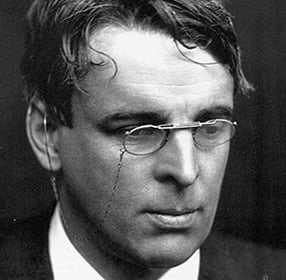
Source: The Rose (1893)
“The Second Coming”
Turning and turning in the widening gyre
The falcon cannot hear the falconer;
Things fall apart; the centre cannot hold;
Mere anarchy is loosed upon the world,
The blood-dimmed tide is loosed, and everywhere
The ceremony of innocence is drowned;
The best lack all conviction, while the worst
Are full of passionate intensity.
Surely some revelation is at hand;
Surely the Second Coming is at hand.
The Second Coming! Hardly are those words out
When a vast image out of Spiritus Mundi
Troubles my sight: somewhere in sands of the desert
A shape with lion body and the head of a man,
A gaze blank and pitiless as the sun,
Is moving its slow thighs, while all about it
Reel shadows of the indignant desert birds.
(The darkness drops again; but now I know
That twenty centuries of stony sleep
Were vexed to nightmare by a rocking cradle,
And what rough beast, its hour come round at last,
Slouches towards Bethlehem to be born?
Source: Michael Robartes and the Dancer. (1921)
Well, I can’t say that this one made me smile, but when I read the first stanza, I was stopped by the chill of recognition. It expressed remarkably my feelings about our country today. Written in 1919, Yeats was devastated not only by the catastrophic losses in WW1, but the horrors in Ireland as it was fighting for independence from Great Britain, and the recent Russian Revolution. “The Second Coming” is considered one of the great poems in the English language and it also “may be the most thoroughly pillaged piece of literature in English.” * Phrases like “Things fall apart,” “the centre cannot hold,” “Slouches toward,” have been used again and again by writers and speakers from Yeats’ day to ours. The first time I read it, I thought, “Why is he using cliches”?
Before commenting on the poem, I’d like to explain a few of the references: 1) The “gyre” in line 1 is how Yeats conceived of history, as a system of moving spirals, each lasting about 2000 years, expanding outwards until the end when, at its largest, it overlaps with the one to come, which is at its smallest. In Yeats’ view, the 20th century was at the point of one gyre, that of Christianity, giving way to the next. 2) The falcon in line 2 is behaving abnormally: A falcon is controlled by his master, the falconer, who commands it and keeps it within a certain area. 3) The Second Coming refers to Christ’s return to earth to rescue the faithful from the apocalypse and take them to heaven, 4) Spiritus Mundi, or spirit of the world, is the term for the theory of the collective unconscious, a store of cultural images and symbols, shared by all humanity and providing inspiration for poets and those open to it.
The first stanza, by an unknown speaker, describes a world that has failed to be civilized, moral, productive, and, in fact, has fallen to an apocalyptic state. The falcon has lost connection with the falconer, cannot hear him, and is spinning out of control. The falconer can be seen as a metaphor for God. In the next line, the gyre is losing its power, the vortex that keeps the center intact, is weakening and “Mere,” (here meaning “pure” ), anarchy is taking over. The “ceremony of innocence” is drowned by the “blood-dimmed tide.” The bloodshed of war has stained the sea. I was puzzled over the word, “ceremony.” It could mean a celebration, a commemoration of innocence, consistent with the rest of the stanza’s examples. Or, it could mean ceremony in the sense of a show of formality, without the sincerity–Yeats suggesting an underlying negative. But I think not. It would be too out of place in the context. The final two lines refer to the discouraging political attitudes of the people and the stanza ends with a sense of hopelessness.
“Surely, some revelation” . . .”Surely the Second Coming. . . “. . . “The Second Coming!” the speaker reacts emotionally to the degradations in stanza 1. And now, an image comes to him from Spiritus Mundi: an Egyptian sphinx with a ” gaze as blank and pitiless as the sun.” Its eyes reflect thoughtlessness, indifference, and a void of emotion. The following comparison to the sun struck me. I’d never thought of the sun as a being. But now it was a brilliant, all-powerful, unthinking presence, uncaring, unchanging, unapproachable. The beast begins its move with the heaviness of “slow thighs,” and the desert birds, “indignant” of the intrusion by the frightening creature, swirl dazedly around, disappearing, only their shadows remain.
“The darkness drops again.” The spell of the World Spirit has lifted, but the speaker has reached an understanding in my two favorite lines; “but now I know/ that twenty centuries of stony sleep/ Were vexed to nightmare by a rocking cradle,” During the 2000 years before Christianity the “stony” sphinx was sleeping, then “vexed to nightmare” by the birth of Christ and by a new age of Christianity that had begun. But what now? The vision that he saw, the “rough beast’ is on its way, his turn at last, but slouching towards Bethlehem, the verb conveying unhurried, unaware, uninterested. The age of Christianity is over and this will be the new one. Yeats feared this possibility and wrote“The Second Coming ” to express his fear and perhaps awaken others to the threat as well. This was in 1919, roughly 123 years ago, but great art resonates throughout generations and I’d say this poem does especially to ours.
*theparisreview.org>4/7/15.
 Poems that Shine